The Trial and Death of Socrates, third edition by Plato G.M.A. Grube (trans.) John M. Cooper (ed.)
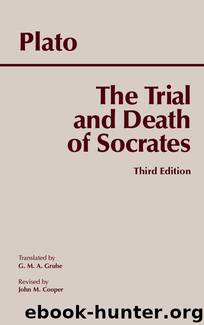
Author:Plato, G.M.A. Grube (trans.), John M. Cooper (ed.)
Language: eng
Format: epub
Tags: ebook
Publisher: Hackett Publishing Company, Inc.
Published: 2011-04-14T04:00:00+00:00
1. The word apology is a transliteration, not a translation, of the Greek apologia, which means defense. There is certainly nothing apologetic about the speech.
2. Jurors were selected by lot from all the male citizens thirty years of age or older who offered themselves on the given day for service. They thus functioned as representatives of the Athenian people and the Athenian democracy. In cases like Socrates’, they judged on behalf of the whole citizen body whether or not their interests had been undermined by the accused’s behavior. Hence Socrates can address them as if he were addressing the people of Athens at large, and in particular the partisans of the democracy against its oligarchic opponents (see, for example, 21a, 32d). Socrates addresses the jury as “men of Athens” rather than employing the usual mode of address, “gentlemen of the jury” (as Meletus does at 26d). At 40a he explains that only those who voted to acquit him deserved that honor.
3. The bankers or money-changers had their counters in the marketplace. It seems that this was a favorite place for gossip.
4. This is Aristophanes. Socrates refers below (19c) to the character Socrates in his Clouds (225 ff.), first produced in 423 B.C.
5. These were all well-known Sophists. Gorgias, after whom Plato named one of his dialogues, was a celebrated rhetorician and teacher of rhetoric. He came to Athens in 427 B.C., and his rhetorical tricks took the city by storm. Two dialogues, the authenticity of which has been doubted, are named after Hippias, whose knowledge was encyclopedic. Prodicus was known for his insistence on the precise meaning of words. Both he and Hippias are characters in Protagoras (named after another famous Sophist).
6. A mina equaled 100 drachmas. In Socrates’ time one drachma was the daily wage of a day-laborer. So Evenus’ fee was a considerable sum.
7. The god Apollo had a very famous shrine at Delphi, where his oracles were delivered through the mouth of a priestess, the “Pythian.”
8. A curious oath, occasionally used by Socrates, it appears in a longer form in Gorgias (482b) as “by the dog, the god of the Egyptians.”
9. Socrates here drops into his usual method of discussion by question and answer. This, no doubt, is what Plato had in mind, at least in part, when he made him ask the indulgence of the jury if he spoke “in his usual manner.”
10. The Council was a body of 500 men, elected annually by lot, that prepared the agenda for meetings of the assembly and together with the magistrates conducted the public business of Athens. (On the assembly, see note to Euthyphro 3c.)
11. Anaxagoras of Clazomenae, born about the beginning of the fifth century B.C., came to Athens as a young man and spent his time in the pursuit of natural philosophy. He claimed that the universe was directed by Nous (Mind) and that matter was indestructible but always combining in various ways. He left Athens after being prosecuted for impiety.
12. The scene between Thetis and Achilles is from the Iliad (xviii.
Download
This site does not store any files on its server. We only index and link to content provided by other sites. Please contact the content providers to delete copyright contents if any and email us, we'll remove relevant links or contents immediately.
Personalized inhaled bacteriophage therapy for treatment of multidrug-resistant Pseudomonas aeruginosa in cystic fibrosis by unknow(214490)
CONSORT 2025 statement: updated guideline for reporting randomized trials by unknow(102521)
Critical evaluation of the ProfiLER-02 study design and outcomes by Vivek Subbiah & Razelle Kurzrock(102044)
Cardiac gene therapy makes a comeback by Oliver J. Müller & Susanne Hille & Anca Kliesow Remes(101838)
Whisky: Malt Whiskies of Scotland (Collins Little Books) by dominic roskrow(74619)
Unveiling the design rules for tunable emission in graphene quantum dots: A high-throughput TDDFT and machine learning perspective by Şener Özönder & Mustafa Coşkun Özdemir & Caner Ünlü(51002)
A yeast-based oral therapeutic delivers immune checkpoint inhibitors to reduce intestinal tumor burden by unknow(40374)
Covalent hitchhikers guide proteins to the nucleus by Alexander F. Russell & Madeline F. Currie & Champak Chatterjee(40296)
Meet the Authors: Christopher R. Mansfield and Emily R. Derbyshire by Christopher R. Mansfield & Emily R. Derbyshire(40206)
Alkaline-earth metals promote propane dehydrogenation with carbon dioxide through geometric effects: Altering the reaction pathway by unknow(32814)
Induced iron vacancies boosting FeOOH loaded on sustainable Fenton-like collagen fiber membrane for efficient removal of emerging contaminants by unknow(32610)
Efficient electric-field-assisted photochemical conversion of methane to n-propanol exclusively over penetrated TiO2Ti hollow fibers by Guanghui Feng(32529)
Bi2SiO5 nanosheets as piezo-photocatalyst for efficient degradation of 2,4-Dichlorophenol by Hangyu Shi & Yifu Li & Lishan Zhang & Guoguan Liu & Qian Zhang & Xuan Ru & Shan Zhong(32468)
A novel NDIPTA organic heterojunction photocatalyst with built-in electric field for efficient hydrogen production by Jiahui Yang & Baojun Ma & Yongfa Zhu(32440)
Enhanced conversion of methane to liquid-phase oxygenates via hollow ferrite nanotube@horseradish peroxidase based photoenzymatic catalysis by Jun Duan & Shiying Fan & Xinyong Li & Shaomin Liu(32405)
Ordered macroporous superstructure of defective carbon adorned with tiny cobalt sulfide for selective electrocatalytic hydrogenation of cinnamaldehyde by Xiao-Shi Yuan & Sheng-Hua Zhou & San-Mei Wang & Wenbo Wei & Xiaofang Li & Xin-Tao Wu & Qi-Long Zhu(32335)
What's Done in Darkness by Kayla Perrin(27253)
Topological analysis of non-conjugated ethylene oxide cored dendrimers decorated with tetraphenylethylene: Insights from degree-based descriptors using the polynomial approach by A Theertha Nair & D Antony Xavier & Annmaria Baby & S Akhila(26631)
Investigation of mechanical and self-healing properties of hydroxyl-terminated polybutadiene functionalized with 2-ureido-4-pyrimidinone by Mohsen Kazazi & Mehran Hayaty & Ali Mousaviazar(26555)
